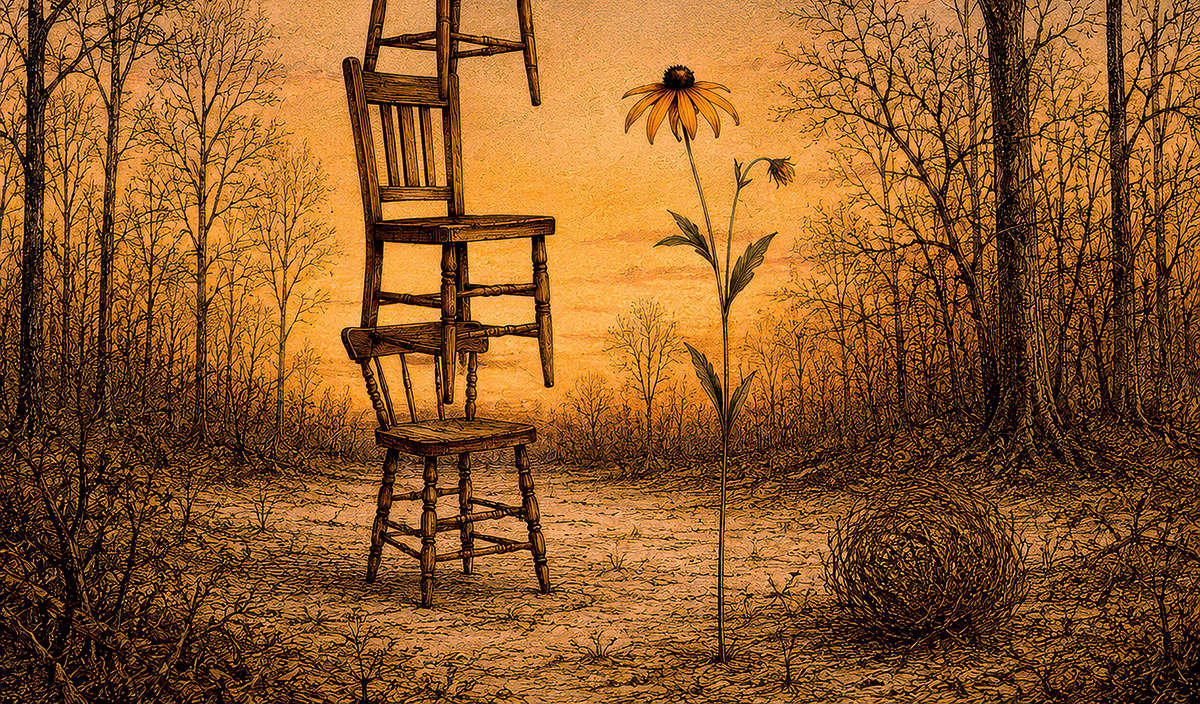
Alan Brown’s interest in making images began in a darkroom. Under its red light, he watched photographs emerge gradually from blank paper. Nothing appeared all at once: the image needed time, attention, and a willingness to wait for what might become visible. That experience shaped more than his understanding of photography. It offered him a way of looking closely at the world and noticing how an image can change as it develops. In Stacked, Brown brings that patient eye to an unlikely scene. A column of empty chairs climbs into a troubled sky, while a single coneflower stands nearby. The arrangement is strange, yet each object is familiar. Brown lets their placement do the work of a story. The longer we look, the more questions arise about effort, growth, balance, and what might remain when the scene changes.
Stacked
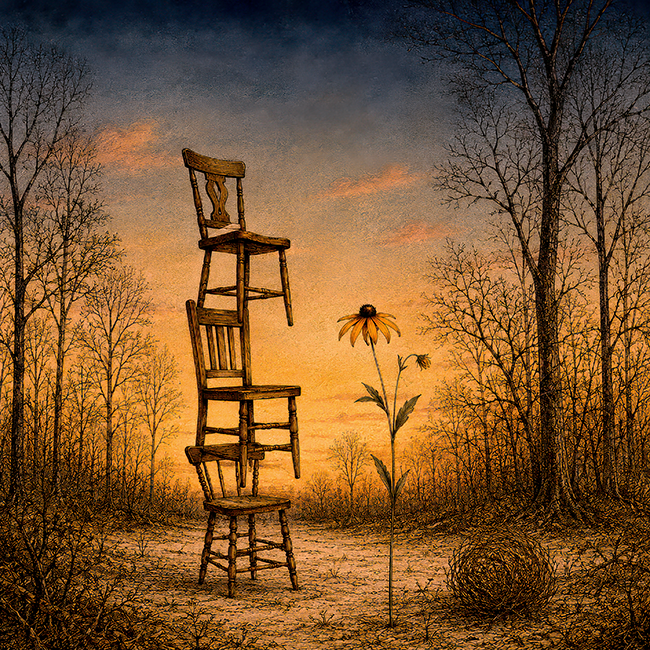
A chair is made to hold someone. In Stacked, each chair is empty, and none appears ready to serve its usual purpose. They have been piled into a tower that reaches far above the ground. The structure asks us to look up, following one chair to the next, even as we wonder how it stays upright. Brown takes an ordinary object and places it in a situation where its usefulness gives way to uncertainty.
Stacking chairs is a familiar act. People do it at the end of a meeting, a meal, or a gathering, clearing a room for whatever comes next. Brown extends that simple action until it becomes unreasonable. The chairs keep rising past any practical need. Their height suggests determination, but it also makes the tower seem vulnerable. A small shift might undo the work of placing them there. The picture leaves us with both the effort it took to build the stack and the possibility that it could fall.
Beside this construction stands a coneflower. It does not compete with the chairs in height. It has no visible support and has not been arranged into a display. It grew where it stands. Against the tower, its presence feels quiet, though its position is no less compelling. Brown gives us two ways of occupying space: one achieved by piling things higher, the other by taking root. Neither is assigned a clear victory.
The sky complicates the scene. Described as bruised, it carries the suggestion of a recent blow or an approaching storm. Its color makes the height of the chairs feel more precarious. At the same time, the sky does not tell us what will happen. The tower may survive the night. The flower may bend, lose its petals, or stand again in the morning. Brown holds the image at the moment before any answer arrives.
That pause makes the work open to several readings. The chairs could suggest ambition: the urge to build higher simply because another chair can be added. They might also evoke the traces people leave behind. Though no one occupies them, their shape recalls bodies, conversations, and gatherings. Their emptiness makes the tower feel both crowded and deserted.
The flower invites questions of its own. It may seem resilient because it holds its place beneath the looming stack, but Brown does not turn it into a simple symbol of nature overcoming human effort. Plants are vulnerable, too. What gives the coneflower its presence is its difference from the chairs. It has reached this point without being lifted by anyone. Its height is modest, and its hold on the ground matters more than how far it rises.
There is humor in the absurd number of chairs, yet the mood is uneasy. Brown allows those feelings to coexist. We can smile at the impractical tower and still feel concern for everything beneath the darkening sky. That shift in response keeps us looking, testing one interpretation against another.
Stacked also asks what we measure when we call something strong. Is strength the ability to rise above everything around it, or to remain in place when conditions change? The chairs and the coneflower offer different answers without speaking for themselves. Brown trusts the gap between them to carry the question.
His early experience in the darkroom offers a useful way to approach the image. As with a photograph slowly appearing on paper, the meaning of Stacked does not have to arrive at once. First we see the chairs and the flower. Then we notice their relationship, the sky behind them, and the uncertain future each faces. Brown gives us time to make those connections for ourselves.
By leaving the outcome unresolved, he keeps the scene alive beyond the moment pictured. We cannot know whether the tower will topple or the flower will still stand in the morning. We can only look at what each has become, and consider why we expect one to last longer than the other.