Jane Gottlieb creates photographic artworks that turn familiar surroundings into worlds shaped by color, imagination, and personal vision. Her work combines photography, painting, and Photoshop. Across an artistic career spanning more than fifty years, she has drawn on photographs taken around the world, returning to these images to explore new possibilities within their compositions. Her approach gives architecture, gardens, and landscapes an unexpected appearance while preserving their connection to places she has experienced.
An exhibition at the UC Santa Barbara Art, Design & Architecture Museum explored her interpretations of France, presenting hand-painted Cibachrome prints alongside versions of the same images transformed through Photoshop. This comparison offered insight into her changing methods and continuing interest in color. Her artworks have appeared in museums, galleries, public spaces, and international art expos, entered private and corporate collections, and been featured in magazines, books, and online publications. Joy remains central to her approach to making art.
Pond at Versailles: Color, Curvature, and a Different View of Nature
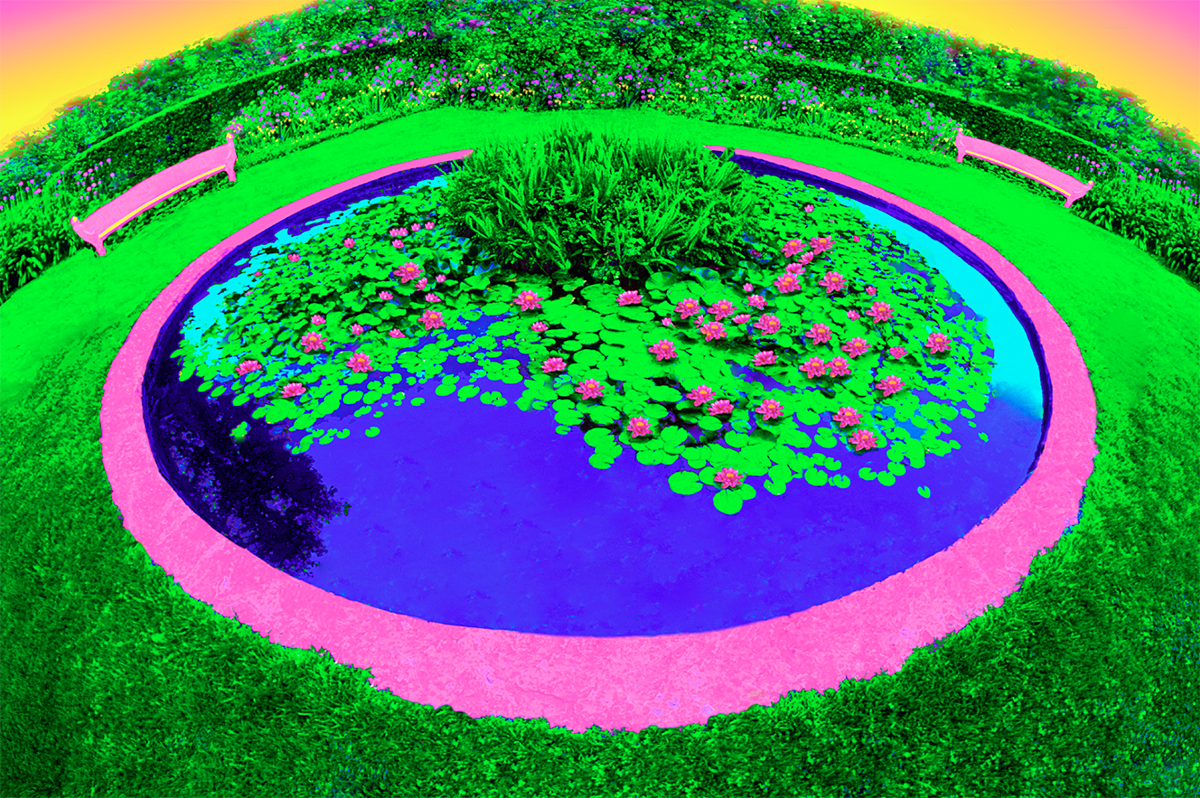
In Pond at Versailles, photographed in 1988 and painted in 1989, Gottlieb transforms a garden scene through an exuberant arrangement of greens, pinks, blues, and violets. The archival hand-painted Cibachrome print retains the detail of its photographic foundation while introducing colors that move the setting beyond ordinary observation. Water, vegetation, stone, and sky become parts of a visual experience guided by the artist’s imagination.
The pond dominates the composition, appearing as a broad ellipse that stretches across the foreground. Its curved border establishes the image’s main structure, gathering the surrounding garden around a central pool. The viewpoint makes this shape especially pronounced. Rather than looking across a distant landscape, the viewer seems positioned close to the water, with the garden opening outward around its edges.
Gottlieb paints the pond’s rim a bright pink, creating a continuous band between the water and the lawn. This border gives the pool definition and introduces a playful quality to its formal design. Pink benches on either side repeat the color, drawing attention toward the background. Their placement creates a visual balance, while their smaller scale helps establish the pond as the image’s focus.
Within that frame, the water shifts between blue and violet. These colors suggest depth while also making the surface feel almost unreal. A darker reflection near the lower left interrupts the brighter expanse, preserving a trace of the garden’s photographic origins. The contrast between shadow and saturated color gives the water variation, encouraging the eye to move across its surface rather than settle immediately.
Floating leaves form clusters across the upper portion of the pond. Their vivid green echoes the surrounding grass, connecting the water to the garden beyond it. Small pink blossoms appear among the leaves, repeating the border’s color in scattered accents. These repetitions hold the composition together. Pink travels from the rim to the flowers and benches, while green moves between lawn, foliage, and aquatic plants.
A dense group of upright plants rises near the center of the pool. Its narrow leaves interrupt the flatter shapes of the floating vegetation, adding texture and a sense of vertical movement. Behind it, the lawn and hedges form layered curves. The garden’s orderly arrangement remains visible, but the intensified palette gives that order a different emotional character: lively, surprising, and slightly dreamlike.
The sky contributes to this transformation. A warm yellow band meets pink toward the upper corners, creating an atmosphere that feels invented rather than recorded. Against this warmth, the green garden appears even brighter. The image brings together colors associated with sunlight, flowers, and foliage, then pushes their intensity until the entire setting becomes an expression of heightened perception.
The hand-painted Cibachrome medium is essential to this effect. Photographic detail provides a recognizable place, while applied color changes how that place is encountered. Gottlieb’s intervention allows observation and invention to occupy the same image. The viewer can identify leaves, reflections, benches, and garden borders, yet each element participates in a palette that belongs to the artist’s interpretation of the scene.
Ultimately, Pond at Versailles invites an attentive, pleasurable encounter with a garden remade through color. Its curved forms guide the eye, while repeated hues create connections across the scene. The artwork demonstrates how a photograph can become a starting point for imaginative transformation. Gottlieb preserves the setting’s structure and textures while giving them fresh energy, offering a view of nature shaped as much by feeling as by sight.