An Artistic Journey Through Heritage and Imagination
Born in 1949 and raised in California’s Bay Area, Deborah K. Tash has developed an artistic practice shaped by poetry, ancestry, and an enduring curiosity about the natural world. Her mother’s Mexican roots and her father’s Celtic heritage inform her identity as a Mestiza, someone whose experience moves between cultural traditions. For Tash, painting and writing are interconnected ways of exploring memory, mythology, and spiritual experience. Her images often bring together recognizable objects and unexpected forms, creating encounters that feel both intimate and mysterious. Rather than illustrating a specific story, she allows symbols, textures, and colors to suggest possibilities that viewers can interpret for themselves. This openness reflects her interest in the spaces between different worlds: the visible and invisible, the remembered and imagined, the personal and ancestral. Her work invites a patient kind of looking, in which even a small fragment can carry emotional meaning.
Illuminated Poems Series / Haiku At Midnight
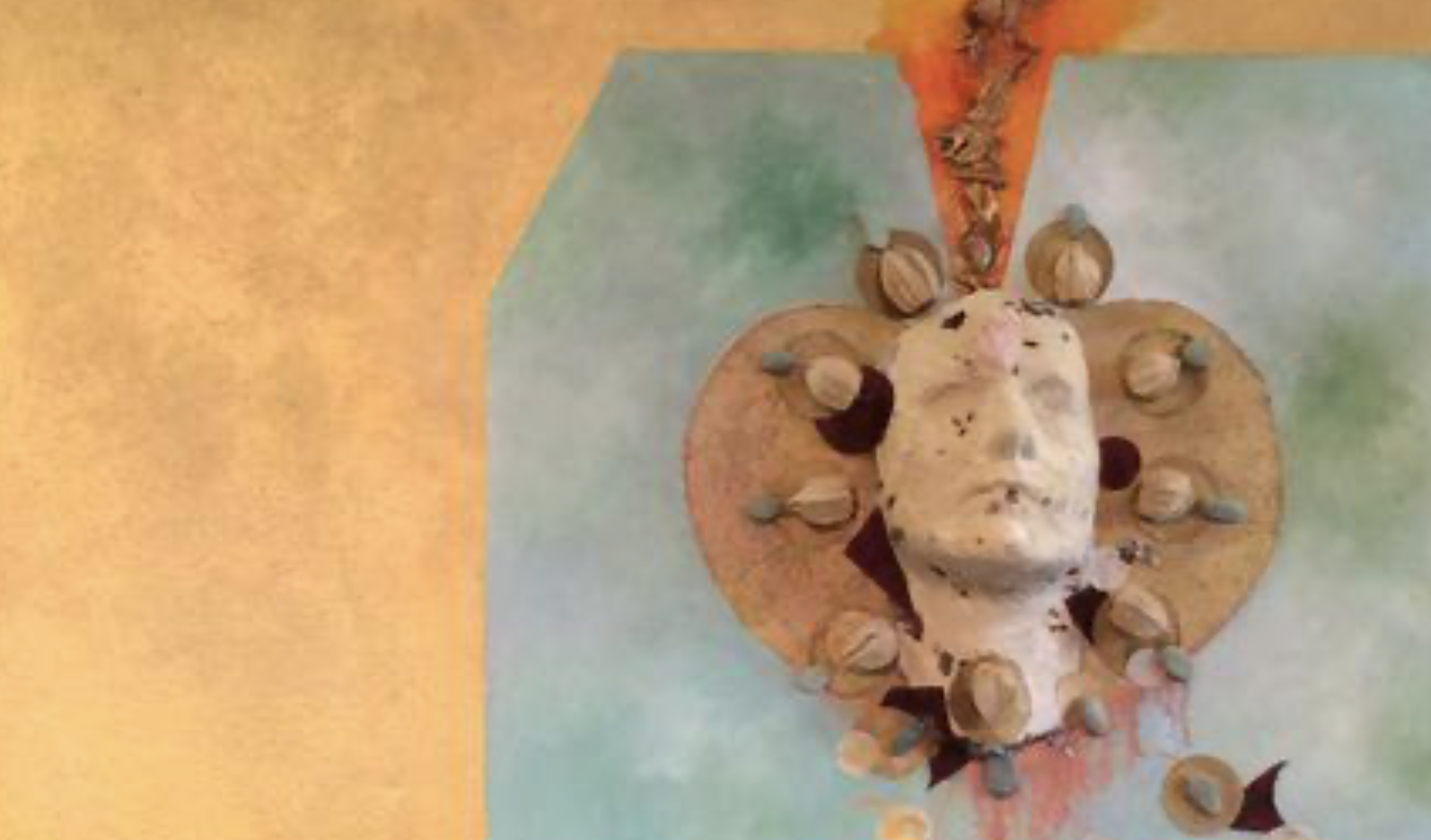
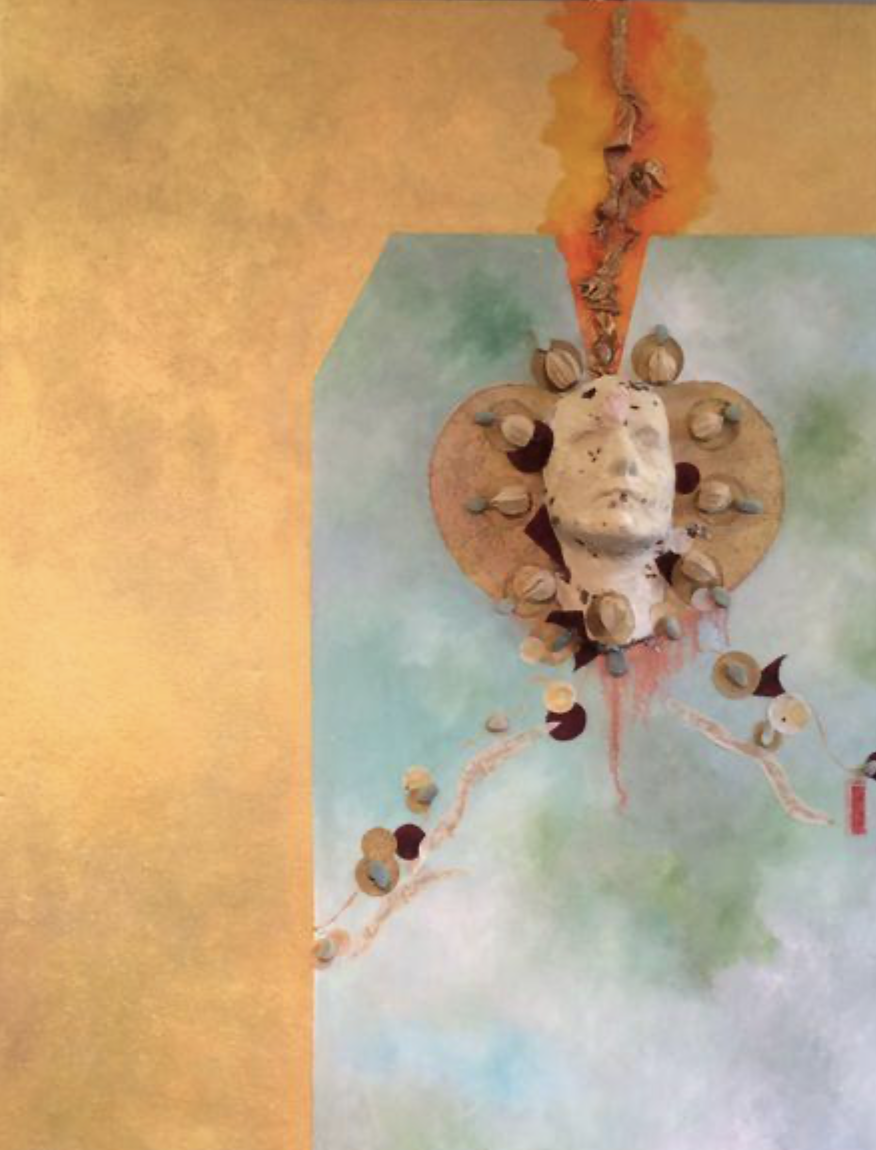
In Illuminated Poems Series / Haiku At Midnight, Tash constructs a dream image through painting, collage, and sculptural detail. A pale mask occupies the center of an abstract blue-green field, surrounded by seeds attached to circular shapes and delicate ribbon accents. Above it, a twisted, breadlike form rises into orange flames. A broad expanse of gold fills the left side of the composition, lending the entire scene a warm, atmospheric glow. These contrasting elements create an image that feels familiar in its materials yet impossible to place within ordinary reality.
The painting’s spacious arrangement is essential to its effect. The golden background appears almost luminous, while the cooler blue-green area suggests a shifting cloud or an undefined landscape. Neither space provides a stable setting. Instead, the mask seems to hover between them, suspended in a world where scale and gravity are uncertain. The open areas give the viewer room to pause before returning to the intricate cluster of objects at the center.
The mask itself is quiet and enigmatic. Its uneven surface, softly suggested features, and scattered dark marks make it appear weathered, as though it has carried many experiences. It does not identify a particular person or offer an obvious expression. The face might evoke an ancestor, a dream visitor, or an aspect of identity that remains difficult to name. Its ambiguity becomes an invitation to consider how faces can hold stories without revealing them directly.
Around the mask, seeds introduce another layer of association. As natural objects, they suggest beginnings, growth, and the possibility of renewal. Placed on earthy circles, they also resemble an improvised ceremonial ornament. Their repeated forms create rhythm, but their arrangement remains irregular enough to feel organic. This mixture of order and spontaneity connects the handmade character of the collage with the unpredictable logic of dreaming.
The vertical shape above the mask changes the energy of the composition. Tash describes it as a twisted bread form, an ordinary object transformed by its placement and the flames that emerge from its top. Bread may call to mind nourishment, family rituals, or everyday survival. Fire introduces a different range of possibilities: heat, danger, purification, and change. Together, they turn a domestic reference into something theatrical and elusive. The flames draw the eye upward, creating movement against the otherwise still background.
Fine ribbonlike trails extend outward, leading toward smaller floating shapes. These lines connect distant parts of the painting without explaining their relationship. They resemble pathways, drifting thoughts, or the loose threads of a remembered dream. Their lightness offsets the solidity of the mask and helps the composition feel expansive rather than crowded.
The title offers a poetic framework for viewing the artwork. A haiku communicates through concentrated images and carefully considered pauses, often leaving meaning unresolved. Tash’s visual language operates similarly. The seeds, face, bread, and flames become brief impressions that gain resonance through their proximity. Midnight suggests a time when ordinary distinctions soften and imagination moves freely between memory and possibility.
The result is not a puzzle with one correct solution. Tash encourages viewers to experience the work through associations, feelings, and personal recollections. In Haiku At Midnight, mixed media becomes a way of giving physical presence to an elusive inner landscape. The artwork holds together stillness and motion, tenderness and uncertainty, offering a moment of reflection in which a dream can remain wonderfully unexplained. Through its unusual materials and delicate visual relationships, the composition continues to reveal new possibilities, rewarding repeated observation and thoughtful engagement.