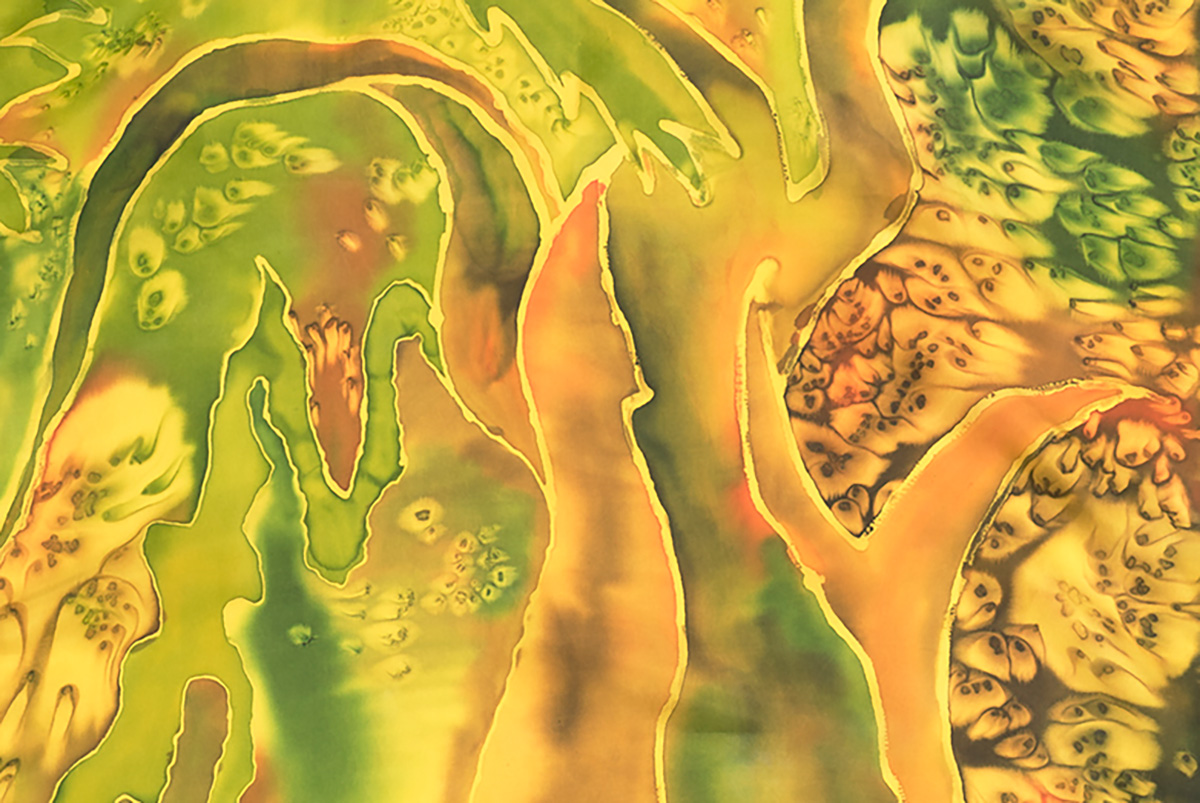
Art offers Kirandeep Grewal a way to examine the experiences, relationships, and cultural influences that give meaning to everyday life. Working from Canberra, Australia, Grewal draws upon her personal history, ancestral heritage, and encounters with the natural environment to create paintings that communicate stories of change, connection, and self-discovery. Her artistic vision is informed by an appreciation for the diverse cultures and communities that have contributed to her understanding of the world.
As both an artist and educator, Grewal recognises the ability of creative expression to bring people together and encourage meaningful conversations. Her work frequently explores the emotional dimensions of migration, the wisdom passed down through generations, and humanity’s relationship with nature. Through expressive imagery and carefully chosen symbols, she transforms personal experiences into visual narratives that resonate beyond her own circumstances. Each composition offers an opportunity to reflect on life’s transitions, the importance of cultural identity, and the strength that emerges from embracing unfamiliar experiences.
Migration (2017)
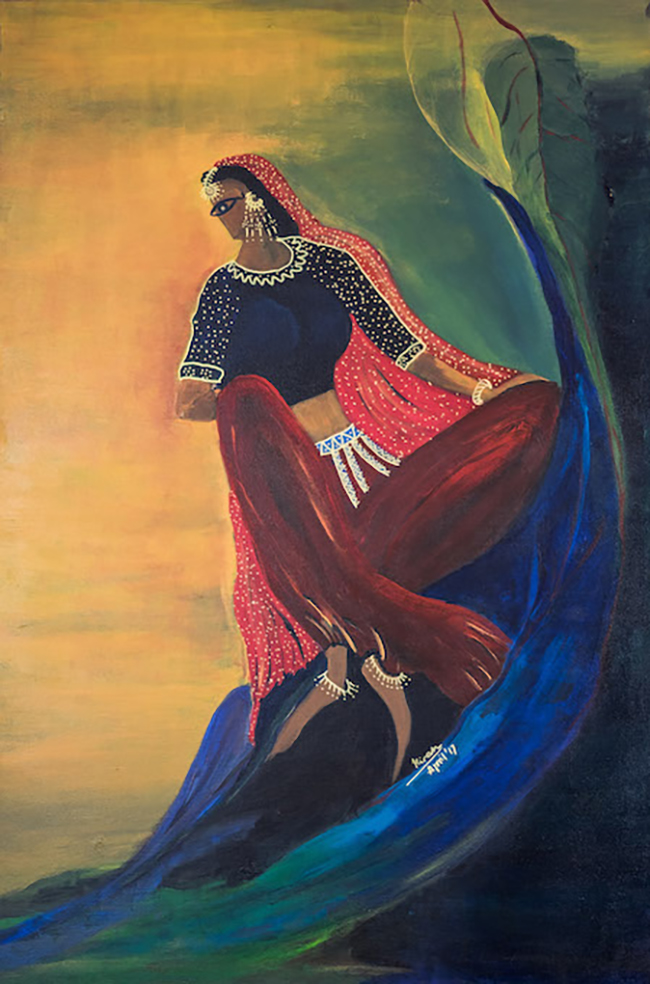
Acrylics on canvas, 92 × 61 cm
Leaving one’s homeland involves far more than crossing geographical boundaries. It can transform how individuals understand themselves, their relationships, and the traditions that have shaped their lives. In Migration, Grewal addresses these experiences through an intimate self-portrait that examines the emotional and cultural realities of beginning a new chapter in an unfamiliar country.
The painting reflects the complex process of adjusting to a different environment while preserving connections to one’s origins. For Grewal, migration has provided opportunities for personal growth and a greater awareness of her own capabilities. The challenges associated with relocation become moments of reflection, encouraging a deeper appreciation of resilience, independence, and the values that remain important throughout life’s transitions.
Cultural identity occupies a central position within the artwork. Grewal incorporates traditional garments and jewellery as meaningful references to her heritage. These elements carry associations with family history, customs, and the cultural knowledge inherited from earlier generations. Their presence reinforces the idea that a person’s sense of identity extends beyond the physical location they inhabit.
Another important aspect of Migration concerns the changing nature of relationships across distance. Moving away from family and familiar communities creates new experiences for those who depart, but life also continues to evolve for those who remain. Over time, these separate journeys can produce differences in perspectives, memories, and shared experiences. Grewal considers this emotional reality with sensitivity, acknowledging that separation involves changes that cannot always be measured through physical distance alone.
The influence of her great-grandmother introduces an especially personal element to the painting. Grewal reflects upon her ancestor’s life with admiration, finding encouragement in the determination, wisdom, and dignity with which she faced her circumstances. These memories connect the artist’s present experiences with a family history that continues to provide guidance and inspiration.
Rather than portraying migration simply as a departure from the past, Grewal presents it as an ongoing negotiation between different worlds. Her self-portrait communicates the possibility of building a new life while maintaining meaningful connections to inherited traditions. In doing so, Migration becomes a thoughtful examination of cultural continuity, emotional change, and the evolving meaning of home.
Mayura on the Waterfall (2018)
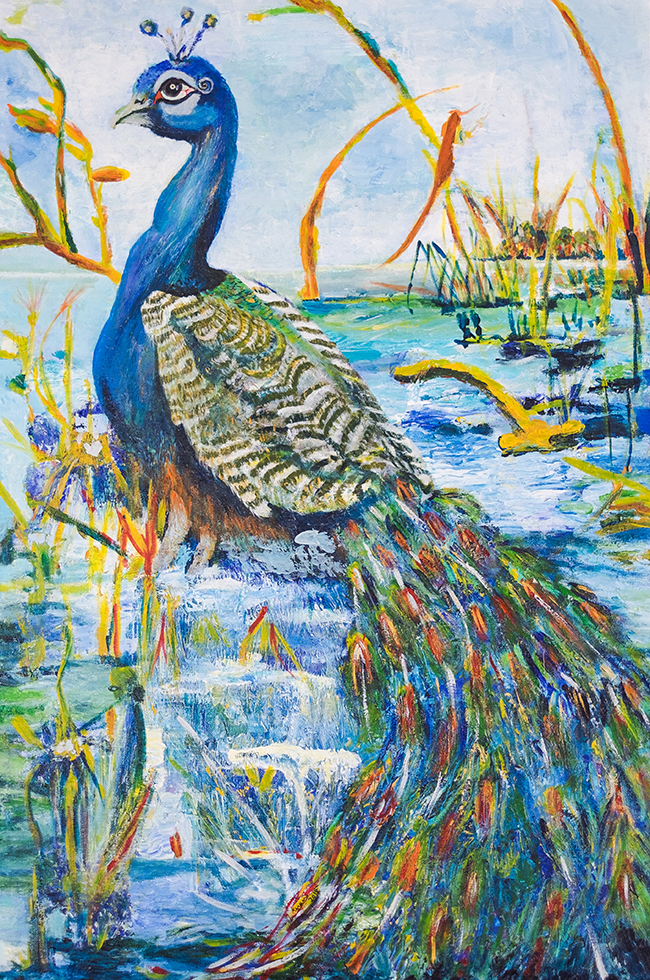
Acrylics on canvas, 61 × 92 cm
Nature becomes a source of philosophical reflection in Grewal’s Mayura on the Waterfall, a painting that considers the importance of confidence, acceptance, and perseverance. Featuring a peacock perched upon rocks beside cascading water, the composition presents a moment of tranquillity within an environment characterised by continuous movement.
The peacock occupies a significant symbolic role. Associated with elegance, beauty, and dignity, the bird represents an individual who maintains composure when confronted with unfamiliar circumstances. Its confident posture suggests an inner stability that does not depend upon the predictability of the surrounding environment.
In contrast, the waterfall conveys the restless and unpredictable qualities of existence. Water moves continuously, responding to the landscape without resisting its natural course. This imagery offers a metaphor for the changing circumstances people encounter throughout their lives, from unexpected challenges to opportunities for renewal.
Grewal establishes a meaningful relationship between these two elements. While the water continues its descent, the peacock remains poised, seemingly comfortable with the movement around it. The bird’s forward-looking gaze reinforces the importance of approaching the future without becoming overwhelmed by uncertainty or attachment to previous experiences.
The painting also reflects the artist’s interest in intuitive expression. Rather than presenting nature solely as a subject of visual admiration, Grewal uses its familiar forms to communicate emotional and spiritual ideas. The encounter between the peacock and the waterfall becomes an invitation to consider how individuals might respond to circumstances beyond their control.
At its heart, Mayura on the Waterfall suggests that strength can be expressed through calmness rather than resistance. By embracing change with patience and confidence, individuals may discover new possibilities for growth. Grewal’s composition celebrates this balance between determination and surrender, presenting nature as a reminder of the beauty found in moving forward with purpose.
Gum Tree (2015)
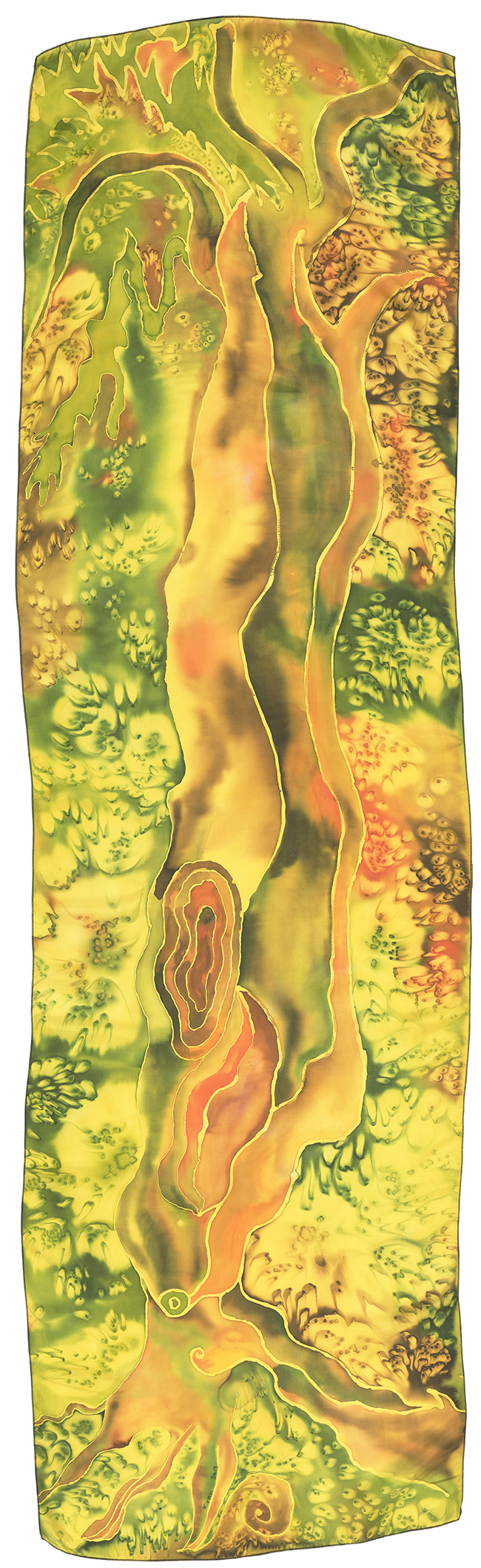
Silk dyes on Indian silk, 54 × 200 cm
Australia’s distinctive landscapes and remarkable natural diversity provide the inspiration for Grewal’s Gum Tree, a silk wall hanging that expresses her appreciation for the country she now calls home. Created with silk dyes on Indian silk, the work combines an Australian botanical subject with a material that carries associations with the artist’s cultural background.
The gum tree holds a prominent place within Australia’s natural environment. Its recognisable form and enduring presence make it an evocative subject through which Grewal explores her relationship with the land. The artwork communicates her fascination with the country’s flora and fauna, while expressing a growing emotional attachment to the environment surrounding her.
Beyond its botanical inspiration, Gum Tree reflects Grewal’s respect for the cultural knowledge of Aboriginal communities. She is particularly drawn to their longstanding relationships with Country and the understanding that human well-being is closely connected to the health of the natural environment. These principles encourage reflection on environmental responsibility, respect, and the importance of maintaining a harmonious relationship with the land.
The artwork’s material qualities also contribute to its meaning. Indian silk provides a connection to Grewal’s heritage, while the Australian subject represents her experiences of establishing a home in another part of the world. Bringing these elements together allows the artist to express the coexistence of different cultural influences within a single creative practice.
The vertical format of the wall hanging further distinguishes the work, offering an extended surface through which the tree can be presented as a subject of contemplation. Its combination of natural imagery and culturally significant materials creates an intimate connection between artistic expression and personal experience.
For Grewal, Gum Tree is ultimately an expression of appreciation and belonging. The artwork recognises the natural and cultural richness of Australia while honouring the artist’s continuing relationship with her own heritage.
Viewed alongside Migration and Mayura on the Waterfall, the painting contributes to a broader exploration of identity, adaptation, and the experiences that shape an individual’s sense of place. Across these works, Grewal demonstrates how personal memories, cultural traditions, and encounters with nature can become meaningful sources of artistic inspiration.