Sebastian Di Mauro is an internationally recognized Australian artist whose multidisciplinary practice explores the relationships between history, material, landscape, and cultural identity. Born in Innisfail, Queensland, and working between Brisbane and the United States, he has developed an influential career spanning more than three decades. With over 45 solo exhibitions and participation in more than 100 group exhibitions, Di Mauro has established a distinctive presence in contemporary art. His creative practice encompasses sculpture, painting, textiles, installation, and artist books, often transforming familiar materials into unexpected expressions of cultural memory. His works are represented in major Australian public collections, including the Queensland Art Gallery | Gallery of Modern Art and the Art Gallery of Western Australia. Through experimentation and historical reflection, Di Mauro continues to challenge conventional interpretations of identity, revealing how objects, traditions, and collective experiences shape our understanding of the past and present.
Where History, Material, and Contemporary Identity Intersect
Throughout his artistic career, Sebastian Di Mauro has demonstrated a remarkable ability to reinterpret familiar cultural narratives through unconventional materials and innovative visual approaches. His work moves beyond traditional artistic boundaries, examining how historical events, everyday objects, and collective memories contribute to contemporary understandings of identity.
Central to his practice is the belief that materials carry meanings beyond their physical properties. By combining industrial elements, textiles, found objects, and historical imagery, Di Mauro creates compositions that encourage viewers to reconsider established relationships between art, culture, and society.
His artistic development has been marked by significant exhibitions, including GREENBACK (2019) at MARS Gallery in Melbourne and Always and Altered at Benalla Art Gallery in Victoria. His GREENBACK series was subsequently selected for Personal Structures – Reflections, presented by the European Cultural Centre alongside the 59th Venice Biennale in 2022. In 2023, he was named a finalist in the Hadley Art Prize.
More recent exhibitions, including Collective Labour (2024) and Unsettled Ground (2026), demonstrate his continued engagement with Australian cultural narratives. His forthcoming exhibition, Catching Stars, scheduled for April 2027 at the Australian Embassy in Washington, DC, will further explore the connections between geography, history, and identity.
Beyond his gallery practice, Di Mauro has completed public art commissions across Australia and internationally, including projects in China and the Maldives. His artistic achievements are documented in two major monographs, Between Material (1998) and Footnotes of a Verdurous Tale (2009). He is also an Adjunct Associate Professor at the Queensland College of Art, Griffith University.
Bolters (2026): Reconstructing the Australian Historical Narrative
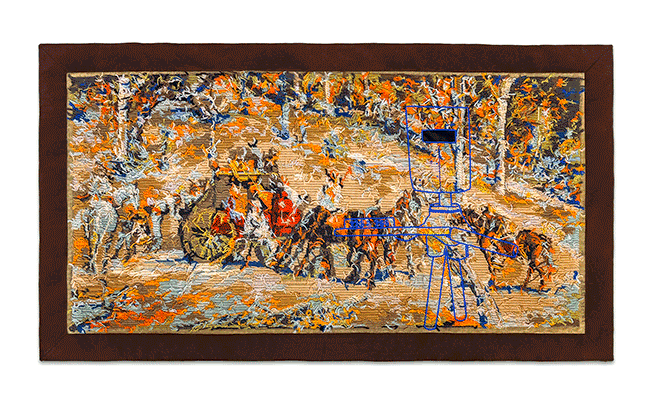
Digital print on Twill Waratah fabric, hand-stitched blended yarn, brown felt border | 66 × 119 inches
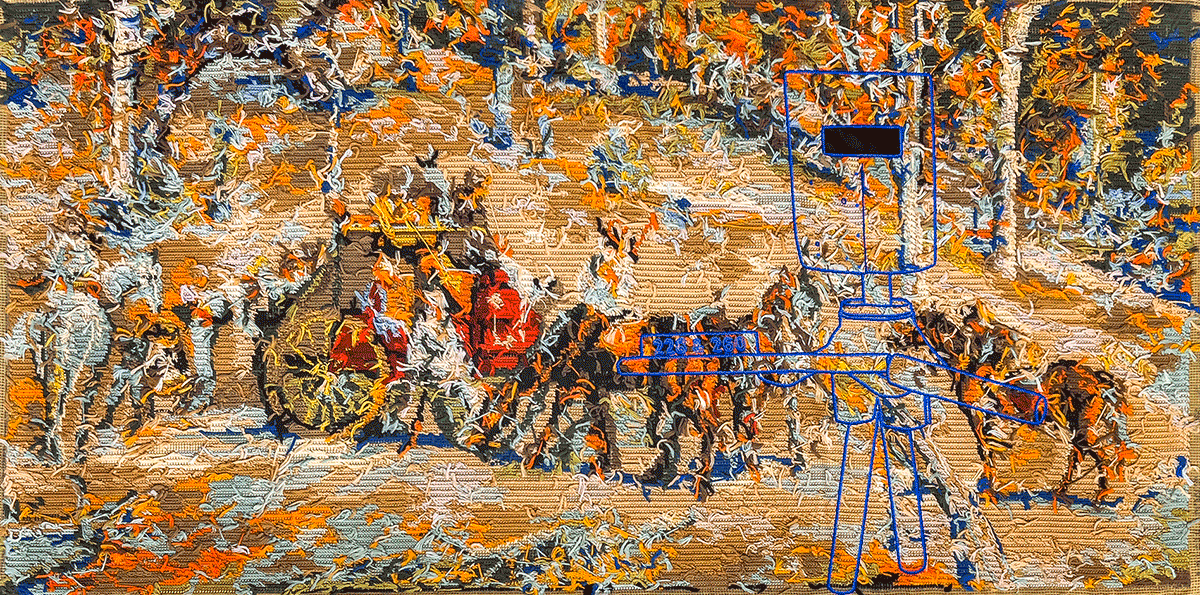
In Bolters (2026), Sebastian Di Mauro revisits Australia’s colonial history through a compelling combination of historical imagery, textile craftsmanship, and cultural symbolism. Referencing Tom Roberts’ celebrated painting Bailed Up (1895), the artwork transforms a familiar representation of bushrangers ambushing a stagecoach into a contemporary meditation on national identity and collective memory.
Roberts, a leading figure of the Heidelberg School, captured the Australian landscape and its colonial narratives through vivid storytelling. Di Mauro reinterprets this historical composition by transferring its imagery onto fabric, introducing intricate hand stitching that disrupts and enriches the original scene.
The composition unfolds through an energetic interplay of vibrant oranges, earthy browns, blues, and contrasting neutral tones. Horses, riders, and landscape elements emerge from a densely textured surface, while overlapping threads create a sense of movement and visual fragmentation. This combination of digital imagery and traditional needlework establishes a dialogue between historical representation and contemporary artistic intervention.
A distinctive feature of Bolters is the superimposed image of a sculptural Ned Kelly figure, constructed from scrap metal and repurposed as a rural letterbox. Bearing the house numbers of two properties in the Northern Highlands of New South Wales, the object transforms one of Australia’s most recognizable historical figures into an everyday domestic fixture.
This unexpected transformation introduces both humor and cultural commentary. Ned Kelly, traditionally associated with rebellion and outlaw mythology, becomes a practical object embedded within contemporary rural life. His symbolic presence raises questions about how national legends are preserved, commercialized, and absorbed into ordinary experiences.
The geometric blue structure of the letterbox contrasts with the richly layered historical landscape, creating a striking visual interruption. Its placement encourages viewers to reconsider the relationship between celebrated historical narratives and the objects through which those narratives continue to circulate.
The use of fabric adds another dimension to the work. Textiles evoke associations with domestic traditions, craftsmanship, and inherited knowledge, while hand stitching suggests the gradual construction and preservation of memory. Through these processes, Di Mauro transforms historical imagery into something simultaneously familiar and unfamiliar.
Ultimately, Bolters challenges the notion of history as a fixed narrative. By bringing together Roberts’ colonial imagery, Ned Kelly’s enduring mythology, and the tactile language of textiles, Di Mauro reveals how cultural identity is continually reconstructed through changing perspectives and everyday experiences.
The artwork reflects his broader artistic vision: transforming materials and historical references into thought-provoking explorations of memory, belonging, and the evolving relationship between Australia’s past and present.