Cheryl Crane Hunter brings a deeply personal sensibility to painting, drawing inspiration from the natural world and the emotions it awakens. With a background in art education, she combines artistic understanding with an intuitive appreciation for the quieter experiences of everyday life. Her paintings explore the relationship between physical surroundings and inner awareness, revealing moments of beauty that might otherwise pass unnoticed.
Nature becomes both a subject and a source of reflection in Hunter’s artistic practice. Through her sensitive treatment of light, atmosphere, and composition, she creates imagery that encourages contemplation and emotional connection. Spirituality emerges naturally within her work, expressed through subtle visual details rather than explicit narratives. Her paintings suggest that ordinary encounters with the environment can carry extraordinary meaning. Whether observing the changing sky or the movement of water, Hunter transforms fleeting experiences into lasting expressions of wonder, tranquility, and humanity’s intimate relationship with the natural world.
The Poetry of Light and Water
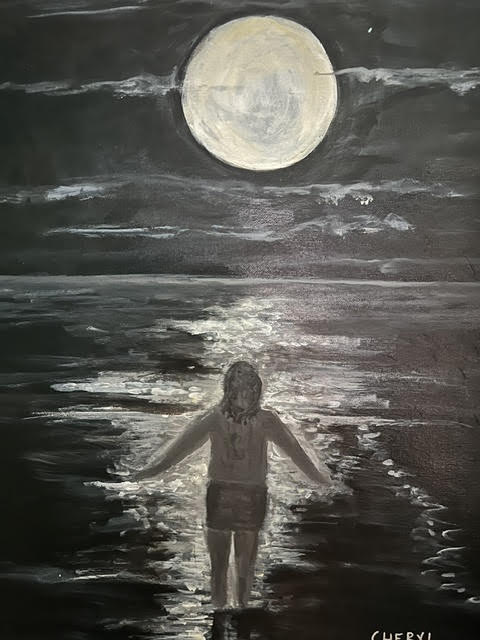
In her monochromatic 16 × 20 artwork inspired by the Hunter’s Moon, Cheryl Crane Hunter captures a remarkable encounter between humanity, nature, and celestial light. Based on a photograph taken by her husband, the painting preserves a deeply personal moment while inviting broader interpretations of peace, love, and spiritual connection. The composition reflects the artist’s fascination with light, particularly the luminous presence of a supermoon and its transformative effect on the surrounding landscape.
A magnificent full moon dominates the upper portion of the painting, suspended against a dark, expansive sky. Its soft, creamy luminosity contrasts with the charcoal tones surrounding it, establishing a powerful visual presence. Delicate horizontal formations of clouds interrupt the darkness, introducing subtle movement without diminishing the moon’s radiance. Hunter’s treatment of the celestial body emphasizes its atmospheric and emotional qualities rather than pursuing photographic precision.
Below, the water becomes a dynamic surface upon which moonlight performs an intricate dance. Irregular strokes of white, silver, and gray suggest ripples continually reshaping the reflected light. The contrast between illuminated passages and darker areas creates depth, movement, and visual rhythm. Hunter captures the unpredictable nature of water, allowing the reflection to appear fragmented yet beautifully connected. These shifting highlights communicate the fleeting character of the experience that inspired the painting.
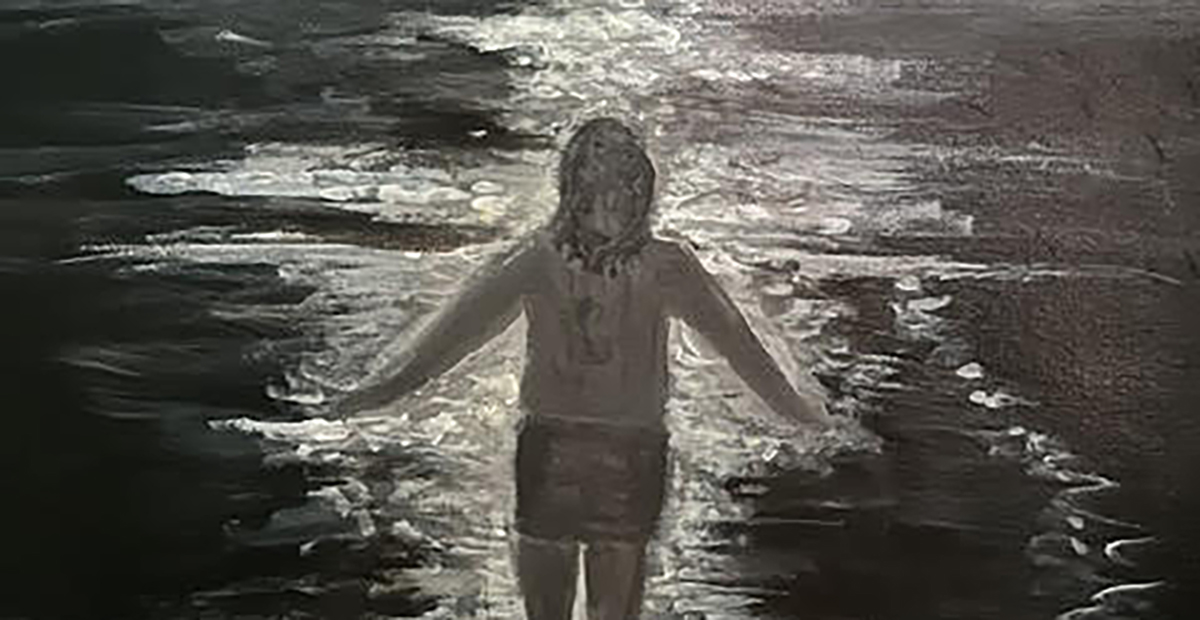
At the center of the foreground stands a solitary figure, facing the moon with arms gently extended. Seen from behind, the individual appears immersed in the surrounding environment, participating in the scene rather than simply observing it. The openness of the gesture suggests receptiveness, freedom, and emotional surrender. Without revealing the figure’s facial expression, Hunter communicates intimacy through posture and placement, allowing viewers to imagine themselves within this peaceful encounter.
The relationship between the figure and the moon is particularly compelling. Positioned along the central axis of the composition, they are visually connected by the luminous reflection stretching across the water. This pathway of light becomes more than a natural phenomenon; it suggests an invisible connection between earthly existence and the vastness of the universe. The figure’s presence introduces a human dimension to the landscape, transforming it into a meditation on belonging and interconnectedness.
Hunter’s decision to work within a predominantly monochromatic palette strengthens the painting’s emotional impact. By limiting color, she directs attention toward tonal relationships, surface textures, and the expressive possibilities of illumination. Darkness is not presented as threatening or oppressive. Instead, it provides a quiet foundation from which light emerges. This balance creates an atmosphere of reassurance, suggesting that beauty and comfort can be discovered even within moments of profound darkness.
The personal origins of the artwork contribute another layer of significance. Working from a photograph captured by her husband, Hunter transforms a shared experience into an enduring artistic expression. The painting becomes a reflection of companionship as much as an appreciation of nature. Its underlying sense of love is communicated through the tenderness of the atmosphere, the openness of the figure, and the gentle movement of light across the water.
There is also a spiritual dimension to the painting that extends beyond its immediate subject. The immense moon, expansive water, and comparatively small human figure invite reflection on humanity’s place within the natural order. Yet the composition conveys connection rather than isolation. The surrounding environment appears to embrace the individual, offering a moment of harmony between the physical world and the inner self.
Ultimately, this artwork embodies Hunter’s ability to discover emotional significance within natural phenomena. Through expressive brushwork, restrained tonal contrasts, and thoughtful composition, she transforms a moonlit evening into a universal reflection on serenity, affection, and wonder. Her painting reminds viewers of the restorative power of nature and the extraordinary beauty found in moments of stillness. Beneath the luminous Hunter’s Moon, light becomes a language of its own, expressing feelings that transcend words and illuminating the profound connections that give life meaning.