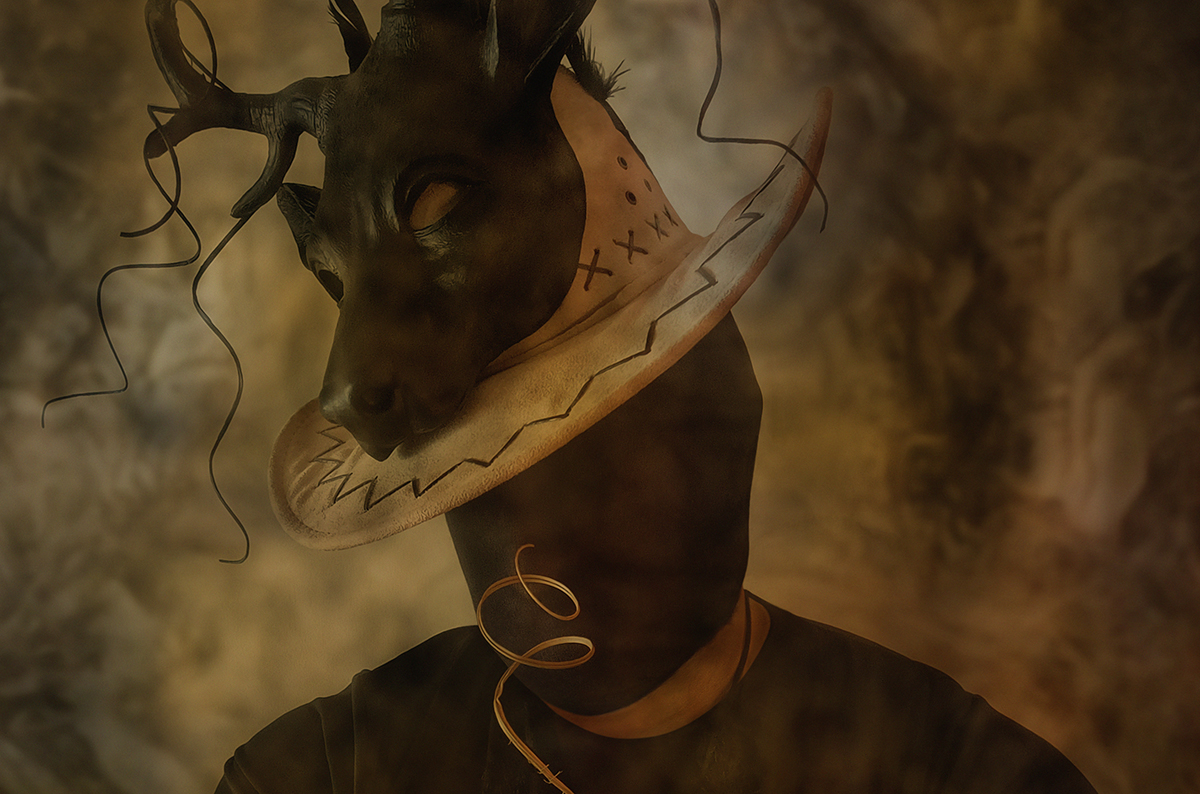
Adamo Macri works across sculpture, photography, video, painting, and drawing, allowing an idea to take shape through more than one medium. Based in Montreal, he often uses the human body as both a subject and a place where materials, symbols, and stories meet. A sculptural form may be made to be worn, photographed, and encountered as an image, with each stage changing how it is understood. Questions of identity, nature, and human existence run through this practice. His figures can seem familiar at first, then become difficult to place: a face is concealed, an organic form becomes part of a costume, or a person appears to merge with an invented creature. Macri has described his process as “documenting sculpture,” a way of treating the assembled figure and its photograph as parts of one event. In his work, transformation remains visible even after the camera has stopped.
Cernunnos Tract (2025)
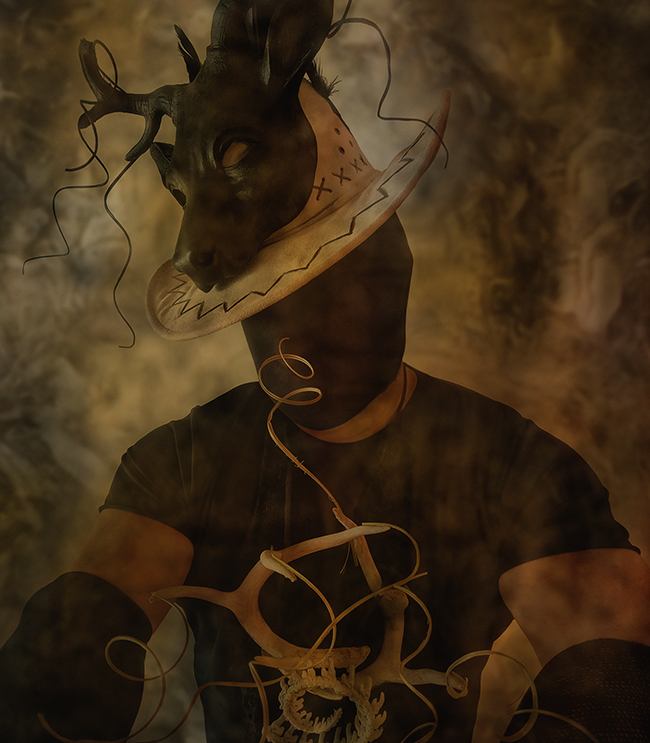
Antlers give Cernunnos Tract its first connection to the ancient Celtic figure whose name it carries. Macri brings that reference into a constructed portrait: a human body appears beneath an elaborate headpiece, while organic textures and markings complicate the distinction between costume and creature. The result suggests a being caught midway through a change. It can be read as a person taking on another identity, or as a new form emerging from materials gathered around the body.
The reference to Cernunnos opens the image to ideas of wildness, fertility, and the relationship between people and animals. Macri does not attempt to recreate a historical depiction of the deity. He draws on the antlered figure’s associations to ask what happens when a person takes on the signs of the natural world. The headpiece has the presence of a mask, but its growthlike forms also make it seem as though it could belong to the wearer. That uncertainty holds the portrait together.
A mask usually promises a change of identity: put it on, and someone else can appear. Here, the change seems harder to reverse. The wearer’s face is obscured, and the additions extend beyond any single feature. Antlers, vegetal elements, and earth toned surfaces spread the transformation across the figure. They draw attention to the labour of making a body into an image, while encouraging the eye to accept the assembled form as a whole. Macri keeps both impressions active. We see the artifice and still feel that the figure has a life of its own.
Photography is central to that effect. The work appears as a staged encounter, with pose, surface, and light gathered into one frame. Macri has spoken about constructing sculptural pieces before applying and photographing them, considering details from accessories and makeup to facial position and lighting. In Cernunnos Tract, that approach allows a wearable object to become more than something displayed on a stand. Once attached to the body, it acquires posture and a sense of presence. The photograph preserves a moment when sculpture is being inhabited.
The setting adds another layer. Instead of placing the figure in a recognizable forest, Macri presents a controlled, ambiguous space. Without trees or a landscape to explain the antlers, viewers must consider what the signs of nature are doing on the body itself. They may suggest kinship with animals and plants, but they can also feel invasive. Growth can enrich a form; it can also overtake it. This tension gives the work its uneasy atmosphere.
That ambiguity makes contamination an idea in the portrait. The word can describe damage, yet it can also describe a boundary that has been crossed. In Macri’s image, the human figure is altered by materials and symbols associated with other forms of life. Myth, too, changes the body: an inherited story shapes what we think we see. A viewer who recognizes Cernunnos may read the antlers through ideas of ritual and wilderness. Another may first encounter an unfamiliar hybrid, then look for clues in its textures and stance. Neither response settles the identity of the figure.
The work also raises questions about self-portraiture. Macri’s broader practice has involved using his own body within constructed photographic works, though the concealed face here makes personal identity less useful as an answer. The figure can carry something of the artist without offering an ordinary likeness. It becomes a means of testing how much can be added to a body before the person beneath it seems to disappear—and whether that person was ever separate from the roles and images placed upon them.
Cernunnos Tract ends with no clear account of who or what stands before us. Its title points toward an old myth, while its careful construction belongs to a contemporary studio practice. Between those points, Macri gives the figure a brief, convincing existence. We can identify the antlers, the mask, and the body; what we cannot identify with the same confidence is where one ends and the next begins.